


Syllabus: GS2/International Relations, GS3/ Economy
Context
- India is pushing for a steel quota in the UK market worth nearly $900 million under the bilateral free trade agreement (FTA) signed in 2025 in a bid to resolve the ongoing row over steel curbs announced by the UK.
Tightened Steel Import Restrictions by United Kingdom
- The United Kingdom announced revised steel safeguard measures that will come into effect from July 1, 2026.
- The country has reduced tariff-free import quotas for steel products and increased tariffs on imports exceeding the quota from 25% to 50%.
- The UK government has justified these measures as necessary to protect its domestic steel industry from global overcapacity and trade diversion.
Concerns Raised by India
- India has argued that the proposed quotas are significantly lower than its current export levels.
- India’s exports of iron, steel, and steel products to the UK amounted to approximately $893.4 million in 2025–26.
- Impact on Indian Industry: This severely hits Indian MSME exporters and high-exposure steel products (such as stainless steel wire rods and welded pipes), which make up a significant portion of India’s steel exports to the UK.
Tariff-Rate Quotas (TRQ)
- TRQ is a two-tiered trade policy used to regulate imports. It allows a specific volume of a product to be imported at a reduced or zero tariff rate.
- Once that volume limit is reached, any additional imports face a significantly higher standard tariff rate.
- TRQs emerged as part of the Uruguay Round Agreement on Agriculture under the World Trade Organization, which sought to convert non-tariff barriers into more transparent and measurable tariff-based measures, a process known as tariffication.
The UK’s Carbon Border Adjustment Mechanism (CBAM)
- The United Kingdom plans to introduce a Carbon Border Adjustment Mechanism from January 1, 2027.
- The initial sectors covered include iron and steel, aluminium, cement, fertilizers, and hydrogen.
- Objectives of CBAM:
- The mechanism seeks to prevent carbon leakage, where industries relocate production to countries with less stringent environmental regulations.
- It aims to ensure fair competition between domestic producers and foreign exporters.
- Concerns for India:
- India’s steel sector is relatively carbon-intensive compared to many developed economies. Indian exporters may face additional compliance costs and carbon-related charges.
- CBAM undermines the principle of Common But Differentiated Responsibilities (CBDR) in climate negotiations.
India’s Transition Towards Green Steel Production
- India is pursuing decarbonisation of the steel sector to achieve its net-zero emission intensity target by 2070 through energy efficiency, renewable energy adoption, green hydrogen, scrap recycling, and Carbon Capture, Utilisation and Storage (CCUS) technologies.
- In 2024, India became the first country to introduce an official Green Steel Taxonomy, defining green steel as steel produced with emission intensity below 2.2 tonnes of CO₂ equivalent per tonne of finished steel.
- By March 2026, 89 steel units had received green steel certification covering 12.34 MT production.
Way Ahead
- India and the United Kingdom should negotiate a mutually acceptable steel quota that reflects historical trade volumes.
- India should accelerate the adoption of green steel technologies and low-carbon manufacturing processes.
- The dispute provides an opportunity to establish effective dispute-resolution mechanisms under the FTA.
India’s Global Position in Steel Sector
- India’s share in global crude steel production increased from 5.2% in 2014 to 7.9% in 2024, reflecting its growing global competitiveness.
- According to the World Steel Association, India is also the world’s second-largest consumer of finished steel.
- Finished steel consumption in India increased from 77 million tonnes (MT) in 2014–15 to 163.7 MT in 2025–26.
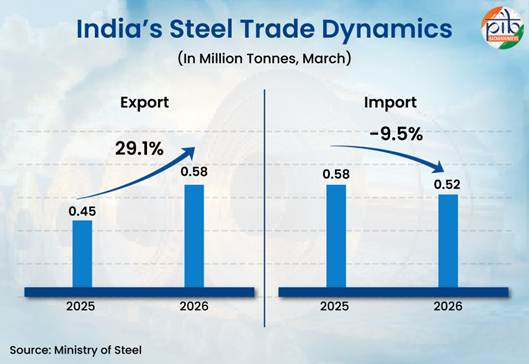
- Top destinations for India’s finished steel exports in March 2026 were Vietnam, Belgium and Taiwan, comprising more than 50% of India’s total finished steel exports.
- India aims to achieve 500 MT steel production capacity by 2047 as part of the long-term industrial growth strategy.
Source: IE
Previous article
AI Falls Short on Extreme Weather Forecasting
Next article
G7 Summit 2026 And India: Voice Of The Global South
